
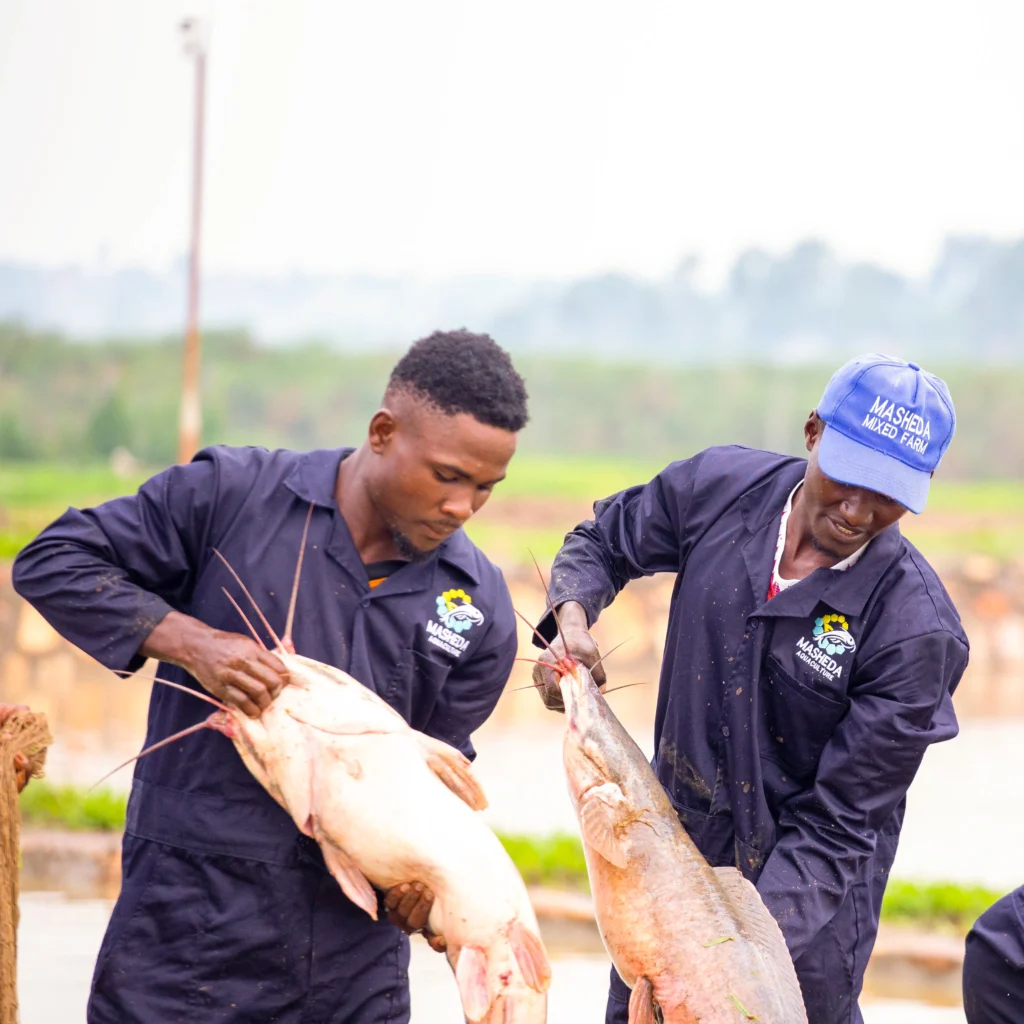
Waste management, an outgrower scheme and hands-on training for street youth are central to how the farm describes its mission.
Masheda Catfish Farm frames its ambitions well beyond fish production. The company’s stated goal is to transform the lives of 30,000 Ugandan youth through training and economic opportunity tied to aquaculture, alongside a broader push toward sustainable, low-waste farming practices.
Training Street Youth
The farm runs a hands-on training program covering the full aquaculture value chain, from pond construction to fish harvesting. According to Lwasa, the company has already trained and equipped roughly 500 street youths with practical skills, using its own hatchery and ponds as a live classroom.
“We teach them everything from pond construction to fish harvesting, providing hands-on training in our hatchery and ponds.” — Marvin Lwasa
An Outgrower Scheme for Local Farmers
Beyond training, Masheda manufactures its own fish feed and runs an outgrower pond scheme that supplies smallholder farmers with fingerlings, inputs and technical support to raise their own fish. Lwasa has described this as a way of extending the benefits of the farm’s controlled, vertically integrated value chain — hatchery, feed and processing — to independent local producers, whose success in turn strengthens Masheda’s own supply base.
Waste Management and Vermiculture
Masheda’s operations extend into vermiculture and waste management, part of a broader sustainability strategy that also includes sustainable packaging and reducing food waste across the production chain. Company leadership has described continual improvement of production and packaging practices as a permanent, ongoing commitment rather than a one-off initiative.
Making the Health Case for Catfish
Part of the farm’s pitch to consumers rests on nutrition. Catfish is high in lean protein and contains omega-3 and omega-6 fatty acids, along with vitamin B12, selenium, phosphorus and potassium. It is also considered lower in mercury than many other fish, and its skin is a source of collagen. Masheda has leaned on this nutritional profile, particularly through its fish powder product, to position catfish as a healthier alternative to more familiar options like tilapia and Nile Perch.
Known locally as emmale in Luganda, catfish was once Uganda’s leading farmed fish species during the 2000s before tilapia and mirror carp overtook it in commercial importance, according to historical FAO data. Industry accounts suggest the current resurgence in Uganda’s catfish sector is being driven largely by market demand and targeted donor-backed projects rather than by policy alone — a trend Masheda’s growth is often cited as reflecting.