
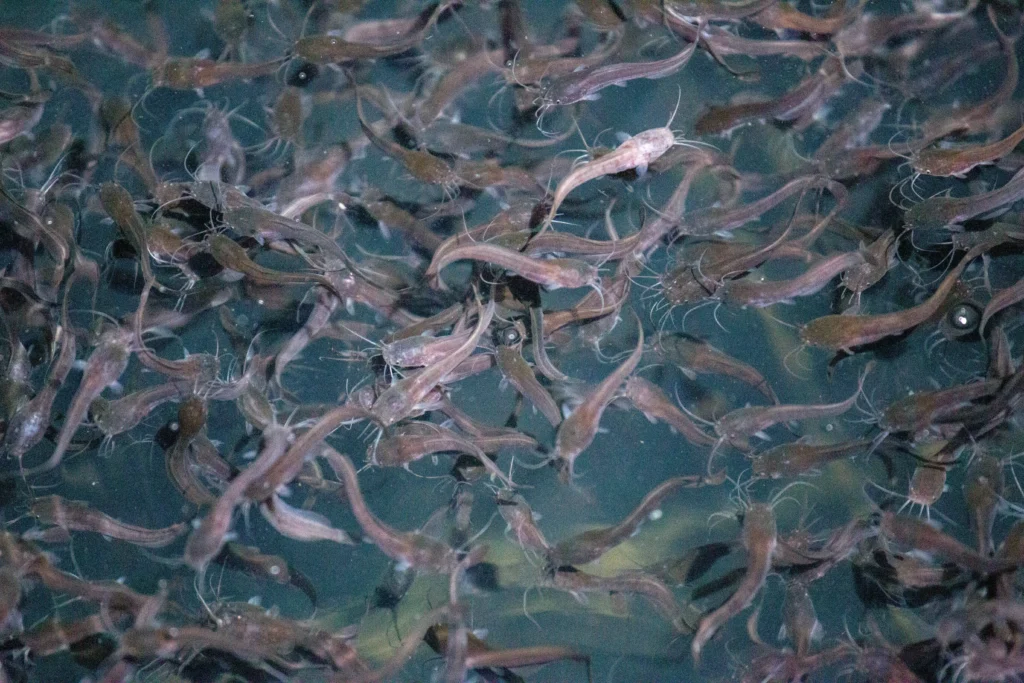
How a Covid-era business idea grew into one of Uganda’s largest commercial catfish operations.
Tucked into the countryside of Buyala, just off Mityana Road in Mpigi District, Masheda Catfish Farm has grown from a single entrepreneur’s idea into one of Uganda’s most significant aquaculture ventures. The farm was founded in 2020 by Marvin Lwasa, who saw an opening in a catfish market that, at the time, was dominated by small and medium-scale producers selling mostly unprocessed fish.
Lwasa’s motivation traces back to the COVID-19 lockdown, a period that pushed him to look for new ways to build a business empire. Rather than simply farming and selling raw fish, he set out to control the entire value chain, from hatching eggs to processing and packaging finished products.
Scale and Setting
Today the farm sits on more than 25 acres and operates 107 fishponds, forming part of the larger Masheda Palm Resort along Mityana Road. Fresh water drawn from the Mayanja River flows through the ponds, which are designed to replicate natural aquatic conditions with controlled water flow and aeration.
- Output: roughly 110 tonnes of catfish produced monthly
- Annual production reported in the millions of kilograms of fish
- Membership in the Uganda Catfish Farmers Association
- A registered supporter of the Buy Uganda Build Uganda (BUBU) initiative
“We are committed to delivering the freshest, highest-quality catfish products while setting the standard for excellence in fish processing.” — Sherina Ainembambazi, Co-CEO, Masheda Foods
A Different Kind of Catfish Business
What sets Masheda apart from many Ugandan fish farms is its refusal to simply sell fresh catfish. Instead, the company built out processing capacity so that most of its fish leave the farm as finished, value-added products rather than whole raw fish. Company leadership frames this as central to competing in both domestic supermarkets and export markets.
Under the umbrella of Masheda Holdings Ltd, the farm and its associated food-processing arm, Masheda Foods, now describe themselves as pioneers in premium, organic catfish products, with an operating philosophy built around environmental stewardship, animal welfare and customer satisfaction.
Why Catfish, and Why Now
Catfish has historically trailed tilapia and Nile Perch in popularity among Ugandan consumers, partly because of the reddish tone of its flesh. Even so, industry watchers note that catfish has overtaken tilapia in global aquaculture output, and demand is rising steadily across West Africa and the Democratic Republic of Congo, where the fish is considered a delicacy. Masheda’s leadership sees that regional appetite, along with growing health-consciousness among Ugandan and diaspora consumers, as the opportunity driving the farm’s next phase of growth.